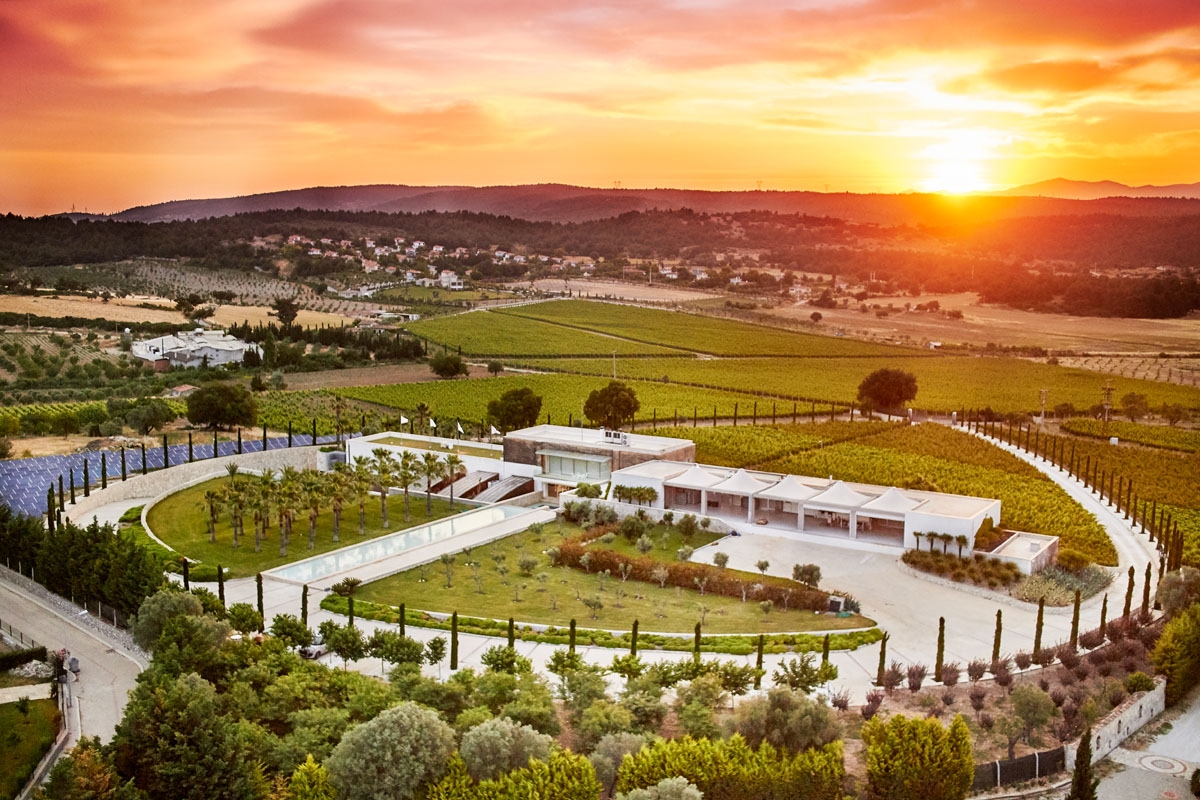
Vineyards begin to appear as the road leaves the coast and moves inland toward Urla. They are not vast — nothing here resembles the industrial scale of other wine regions. Instead, small plots climb the hillsides, often bordered by olive groves or stone walls that date back centuries.
Wine has returned to this peninsula. The land once supported Greek viticulture, but the vines disappeared with the population exchanges of the 1920s. What exists now is a reconstruction — modern winemakers replanting varieties suited to the Aegean climate, building cellars in converted stone buildings, and producing bottles that rarely leave the region.
The Structure of Urla Wine
The Urla wine region is compact. A dozen or so producers work the land, most within a short drive of one another. They share equipment, trade knowledge, and pour each other's wines at their own tables. There is competition, but also cooperation — a recognition that the region's reputation depends on collective quality.
The dominant grapes are Mediterranean. International varieties grow here, but so do indigenous ones — whites with aromatic intensity, reds that produce lighter, more approachable wines. Producers increasingly favour these local grapes, understanding that they express the land more honestly than imported varieties.
How the Vineyards Work
The estates vary in approach. Some emphasise structure and refinement — careful winemaking, controlled fermentation, wines built to age. Others pursue a more natural path — minimal intervention, ambient yeasts, bottles that shift from vintage to vintage. A few focus on organic cultivation, producing wines difficult to find outside the peninsula.
What unites them is scale. These are not industrial operations. Most vineyards are family-run, with cellars small enough that the winemaker pours the tastings himself. Production is limited. Bottles sell out. The wines that reach restaurants in Istanbul or abroad represent a fraction of what is made.
Dispatches from the peninsula
Notes on travel, food, and the Western Aegean. No agenda.
Thank you — first dispatch on its way.
The Experience of Visiting
Tastings here are not formal. Most estates welcome visitors without appointment, though calling ahead is courteous. The experience is personal — a table set outside the cellar, a conversation about the vintage, a bottle opened and shared.
There are no tour buses. No gift shops stocked with branded merchandise. The vineyards of Urla remain, for now, the province of those who seek them out — or those guided by someone who knows which gates to enter.
What they offer is not spectacle but clarity: wine made from the land you can see, poured by the people who made it.
The peninsula's wines are quiet. They improve with attention.