The Aegean coast was once lined with cities. Greek settlements occupied nearly every harbour, every defensible headland, every valley with access to the sea. Most have disappeared — absorbed into later towns, quarried for building stone, or buried beneath centuries of sediment. But two remain legible on the Western Aegean: Ephesus, among the ancient world's most significant urban centres, and Erythrae, a quieter site overlooking the coast near Çeşme.
Together, they anchor the peninsula's deeper history — a reminder that this coast has been inhabited, cultivated, and contested for millennia.
Ephesus
Ephesus lies inland from the modern coast, near the town of Selçuk. In antiquity, the city sat at the mouth of the Cayster River, its harbour open to the Aegean. Silt has since pushed the shoreline westward; the ruins now stand several kilometres from the sea.
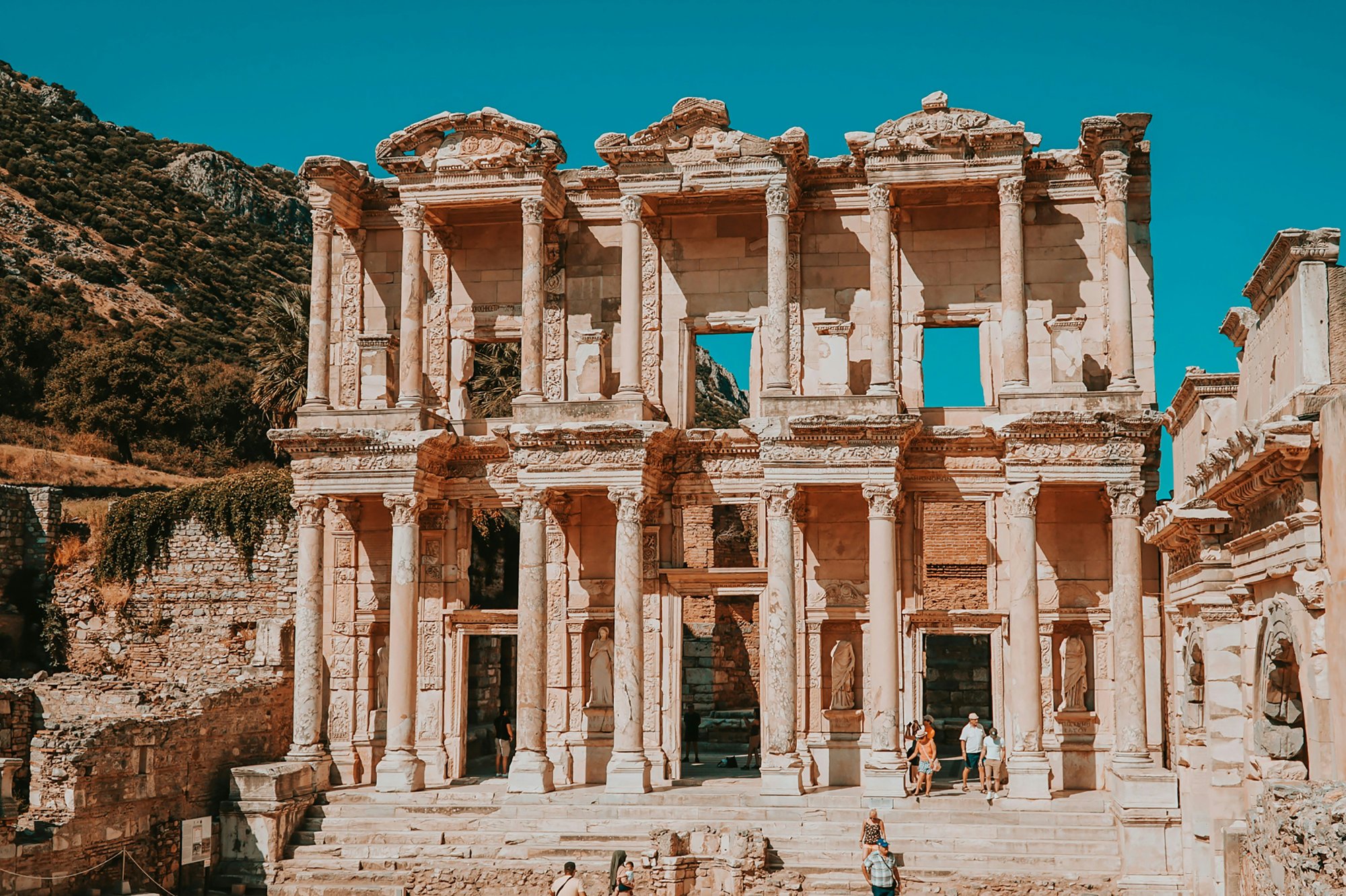
What remains is substantial. The Library of Celsus, reconstructed from its fallen stones, anchors the lower city. A marble street climbs toward the theatre, which once held twenty-five thousand. Terraced houses, opened to visitors in recent decades, reveal domestic life in unusual detail: frescoed walls, mosaic floors, heating systems beneath the stone.
Ephesus was not merely a city but a centre — of commerce, of religion, of intellectual life. The Temple of Artemis, once among the Seven Wonders, stood nearby. Saint Paul preached here. The city's significance extended across the Mediterranean.
Visiting requires adjustment. The site is large, exposed, and crowded in high season. Early mornings or late afternoons offer better conditions. The scale rewards patience — details emerge slowly, across hours rather than minutes.
Dispatches from the peninsula
Notes on travel, food, and the Western Aegean. No agenda.
Thank you — first dispatch on its way.
Erythrae
Erythrae is smaller, quieter, and far less visited. The ruins occupy a hillside above the village of Ildırı, on the Çeşme peninsula. The site overlooks the sea, with views extending toward the Greek islands.
The city was one of the twelve members of the Ionian League, a confederation of Greek settlements that dominated the Aegean coast in antiquity. It prospered on trade, produced oracles of regional importance, and maintained ties across the Greek world.
What survives is fragmentary: sections of defensive walls, the outline of a theatre cut into the hillside, scattered column bases and inscribed stones. The site has not been extensively excavated or restored. Visitors walk among olive trees and wild grasses, piecing together the city's plan from what remains visible.
This incompleteness is part of the appeal. Erythrae asks for imagination. The setting — the hillside, the sea, the silence — provides context that interpretation boards cannot.
Two Histories, One Coast
Ephesus and Erythrae represent different scales of ancient life. One was a capital, dense with monuments and significance. The other was a provincial city, important in its time but now reduced to fragments.
Both, however, confirm the same truth: this coast has depth. The villages, vineyards, and harbours of the Western Aegean sit atop layers of prior habitation. The landscape holds more than what is immediately visible.
Understanding this changes how the peninsula appears. The stone walls of Alaçatı echo building traditions that extend back centuries. The harbours of Sığacık and Karaburun occupy sites chosen by earlier seafarers. The vineyards of Urla grow in soil that has been cultivated, in some form, for three thousand years.
The peninsula is not new. Its character has accumulated across time.